A blog from University of Borås

Tuesday, September 13, 2011

Hydropower plants: friend or foe?

Hydropower plants are generally considered as one of the most environmentally friendly methods for production of electricity. That's correct, if all the ecological aspects of the dams are considered. However, there are some cases that the hydropower plants are foe than friend to the environment.

There is a recent debate on Brazilian hydropower plants. The dams in this country result in flooding of the forest area. It result in anaerobic digestion of the organic materials (wood, leaves, etc.) in the water and formation of biogas and methane, which is 21 times worse than CO2 for the environment. Some studies show these hydropower plants to threat the environment more than fossil fuels. I believe it is a complicated case and could be true or not, depending on how to consider the factors. However, what is clear is the necessity of considering all the ecological aspects of each project.

Another similar case is the largest lake in Iran with 5,200 km2 called Orumieh, which is drying most likely because of the bad management and the dams of the feeding rivers. Dryness of this lake will result in disaster for the entire region, in terms of the ecological aspects, spreading the salts, and not least the economy of the people in that area. Lets hope for a higher weight facctor fot the environment in considering such projects.


(A hydropower plant in Brazil. The photo taken from SR)


(The large Urmia lake that is drying now)

Saturday, September 10, 2011

Glass recycling in Sweden

When it comes to recycling of the waste materials, glass is generally one the materials that is considered to be recycled. Sweden has developed dedicated collections of trasparent and color glasses that are avialable close to all residential areas.

The data from 2009 shows that more than 90% of the glasses were recycled in Sweden. This recycling is mainly carried out by a company named "Svenska GlasÅtervinning". It is a good business with 177 million SEK turnover of just this company (data for 2010) as well as good for the environment.


(Recycling center for glasses. Photo from Göteborg Posten)

Monday, September 5, 2011

Making money of hazardous wastes

I was surfing today on the news, and I saw a conflict in Tehran which was about the wastes of a private hospital and its leakage that run on the street. Actually, this is a problem in many cities and countries.

Hazardous wastes should usually get the first priority in treatment and should not be mixed with other wastes. When talking about the hazardous wastes, we may talk about the hospital wastes, or the wastes containing organics like PCB, heavy metals such as cadmium, acids, bases, corrosive materials, silver, mercury, oils, etc.

One of the big companies in Sweden is SAKAB, that recieves about 500,000 tons/year hazardous wastes from different cities in Sweden. They have different technologies to take care of various hazardous wastes, and produce electricity and heat. It is a double payment for recieving the wastes and also selling the products, with almost nothing left to the environment. I wish them good luck with their work, and hope to see more such companies around the world.


(The plant at SAKAB in Kumla, Sweden that take care of the hazardous wastes)

Thursday, September 1, 2011

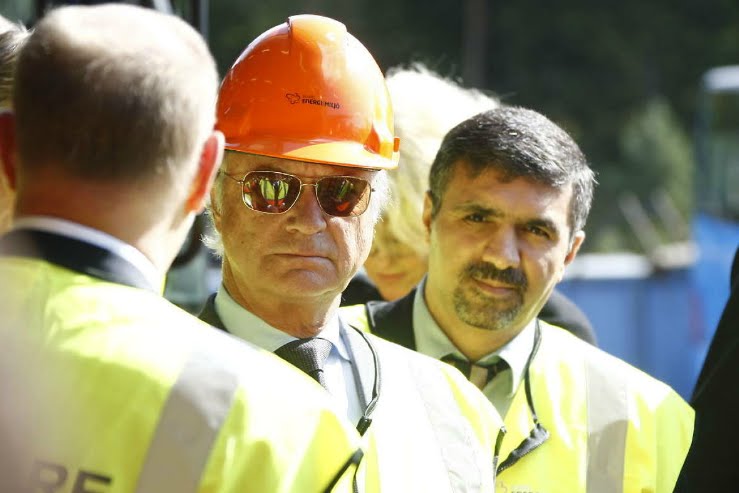
Swedish Royal Family visited Waste Recovery

We had great day today with the visit of Swedish King Carl XVI Gustav and the Queen Silvia. As far as I know, it was their first visit to Borås together. It was a great PR for our work in Waste Recovery, which has a total solution to waste problems in its organization, including education, research, planning and implementations of waste treatment and resource recovery. When it comes to this total solution, we can most likely say that Borås is the best in Sweden, Sweden is the best in Europe and Europe is the best in the world.

Both the King and the Queen showed great interest to our work and the model that we develop for a more sustainable world, better environment and a better life of the scavengers!


(The king, queen and me, Photo taken by Borås Tidningen)

Monday, August 22, 2011

Waste Recovery: From Indonesian scavengers to Swedish Royal family

In Feb. 2006, I traveled to Indonesia to consider starting a research collaboration on ethanol with Gadjah Mada University in Indonesia. However, the huge difference in waste treatment in Sweden and Indonesia, changed our minds and we put waste treatment in focus. It was starting a long jurnery that I and my friend Olle Engström (politition and member of city council in Borås) started together since Nov. 2006.

Today, there are several organization involved in waste recovery, including our university, City of Borås and its political instrument, the research institute SP, the municipal company Borås Energy and Environment, the local authorities in Sjuhärad (several municipalites) and about 15 companies. Our work started in Indonesia and is now extended to Vietnam, China, Nigeria, Brazil, USA, in addition to several other countries that we are now discussing to start collaboration.

There are almost continuous visitors from other countries to Borås and even the model of collaboration (double triple helix) is now extending to develop into other areas.

We are very happy to see this work is even interesting to our royal family. They will visit us next week and will listen to our rector Björn Brorström about waste recovery.

It is great moment for us, who see one day scavengers, one day polititions, one day company managers and one day his magesty Carl XVI Gustav and the Queen Silvia.


(Walking on top of a hill of closed landfill in Sao Paulo, Brazil)


(An scavenger in a gargage sea in Lagos, Nigeria)


(An scavenger in Pontianak, Indonesia)


Friday, August 19, 2011

District heat: A major advantage of Swedish energy system


District heat (or fjärrvärme in Swedish) is a costly investment, but with many advantages. In many countries in the world there is a network of electricity, but not district heat or chill as we have in Sweden. When you burn coal, oil, nuclear energy, biomass etc. to produce electricity, the efficiency is generally about 40%. It means just 40% of the original energy is recovered in form of electricity, while the rest of the energy (about 60%) will be lost in form of heat. Therefore, we see big cooling towers as part of the power plants.

There is similar problem in industries. When the industries consume energy (electricity, oil etc.) to run their equipment, a major part of this energy is converted to heat, and in many cases, they have to get rid of this energy (heat).

Sweden is a cold country with the average temperature of 4.8 C for the whole country through the year. Many cities in Sweden have district heat system to heat up the houses. The energy companies burn waste, biomass etc. and produce electricity and the rest of the energy is fed to this distric heat system and transported to the households. It creates a good income by:
1) getting paid via collecting the wastes,
2) selling electricity
3) selling district heat
In addition, the companies (such as refineries) with waste heat are connected to this network of district heat. It means an extra income for these companies, while their competitors in other countries have to pay to get rid of this energy.

In Sweden, 69 TWh district heat was produced in 2010, where 9 TWh was lost through the system and 60 TWh was delivered to the households. The energy source was dominated by hosehold wastes and biomass (figure below). The complete report can be found here!


(Distric heat production in Sweden in 2010 from different energy sources)


Monday, August 8, 2011

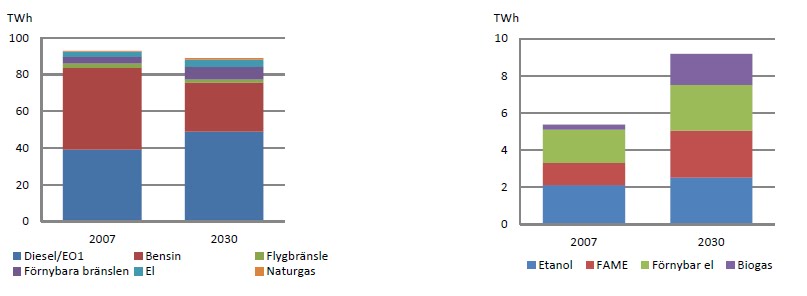
Energy use in Sweden 2030

There was a recent report from The Swedish Energy Agency showing the total energy use in Sweden will increase to 662 TWh, which is 5% more than its level in 2007 which was 629 TWh. The prognosis shows 30 TWh increase in electrity production, in which the wind turbines will produce 10 TWh more electricity. When it comes to the market, the industry will incease their energy consumption, while the household and services will reduce their consumptions.

The total consumption of transportation fuels in Sweden will reduce from 126 TWh to 125 TWh. However, the development of different fuels will be different. While the consumption of gasoline will be drastically reduced, the consumption of the biofuels and diesel will be increased. As shown in this fugure, the biggest jump will be the biogas. You can read the whole report here (in Swedish)!


Tuesday, August 2, 2011

How was the weather?

Good weather here in Europe means sunny, while bad weather usually corresponds to rainy weather. There are similar definitions among people in many countries. However, in several parts of the world, people are suffering from the shortage or lack of "rain". I was in my home town in Isfahan, which is a beautiful city in Iran, and a turist attract of the country. However, the big river of the city was dry this summer, because of the lack of rain. It resulted for 300,000 of the farmers in the eastern part of the city to lose their job!

We see also on the news that people in African horn are starving to death. These are not the only regions that suffer from the too "good" weather (sunny and no rain). North of Africa, Middle East, Spain, Iran, Pakistan, India, USA, Mexico, Australia, etc. (that are located around 30 degree in latitude) are partly or totally suffered from the dryness. These climate changes are partly affected by global warming and increasing the level of greenhouse gases such as CO2. The capacity of our earth is not enough to absorb our emissions. So, we should continue suffering from these disasters!


(An old bridge in Isfahan over a river that was once full of water)

Friday, June 24, 2011

Should I run my car on ethanol?

In 1998, when I attended to a conference in Wisconsin, USA, there was a big dispute between those who love ethanol and those who hate ethanol. Each of them had their own reason to defend or attack fuel ethanol. At that time, oil industry was on one side, and farmers on the other side. This debate is still going on, in which one is for ethanol such as this one (sorry in Swedish) or against ethanol, such as this one.

Today, we see ethanol production in the world has passed more than 70,000,000,000, which is about 5 times more than its lever in 1998. It is a big business for many people in the world. However, we are still running on the first generation of ethanol, and we have no commercial second generation yet. The fact is that we have no single substitute for oil, and I believe we will have several different alternatives in the fuel market in the future. Now, there are many people believe in e.g. electrical vehicles. It is a good alternative for the cities and reducing CO2 emissions. However, are we allowed to destroy the amazon forests in order to access the lithium in that area for the batteries in electrical cars? It seems this debate will continue as long as we need energy (i.e. for ever).....

Tuesday, June 21, 2011

Resource Recovery

I read recently in the news that production of bioplastics will increase from 700,000 tons in 2010 to 900,000 tons this year and 1,700,000 tons in 2015. Europe in the biggest market of the bioplastics, where also the research and development is dominant. We at resource recovery at University of Borås are also working on this direction. Our vision on increasing the value of wastes in form of different products is presented in the following picture, while we have now intensive research on some fo these directions!